


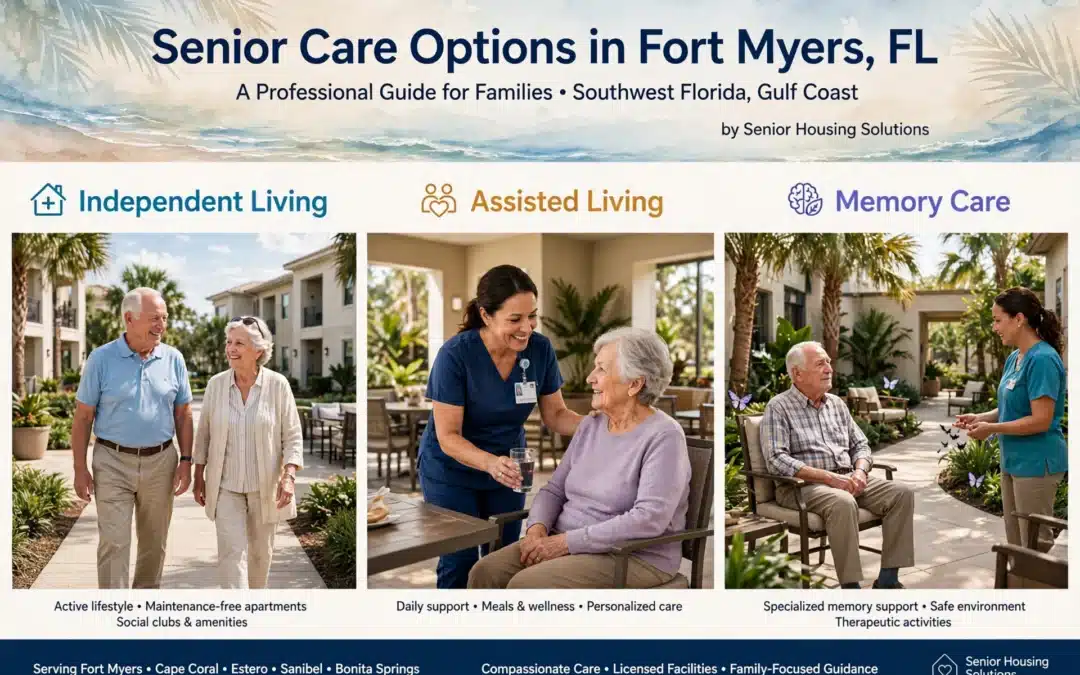
Senior Care Options in Fort Myers, FL: A Professional Guide for Families
By Bruce Rosenblatt, Eldercare Consultant & Owner, Senior Housing Solutions — Certified Dementia Care Practitioner
Choosing senior care in Fort Myers is a care decision first
When a parent starts missing medications, struggling with bathing or dressing, or no longer feels safe at home alone, families in Fort Myers face a decision that is medical and personal at the same time. It is not simply a search for an apartment. The right choice depends on how much help your loved one needs today, how those needs are likely to change, and which local community can actually deliver that level of care, every day.
Fort Myers offers a lot of choice, which is both an advantage and a problem. There are more than 100 assisted living facilities in Fort Myers and the surrounding areas, including Cape Coral, Estero, and Bonita Springs. Communities differ widely in staffing, memory care training, safety systems, pricing structure, and availability. Two communities with similar monthly rates can provide very different levels of care.
This guide explains the levels of care available in Fort Myers, what care typically costs, the signs that it may be time to make a move, and how to evaluate quality before you tour. It is written for adult children and family caregivers who are planning ahead, as well as for families making a decision quickly after a hospital stay or a fall.
Understanding the continuum of senior care in Fort Myers
Most families do not need every level of care — they need the right one. Start with what your loved one can and cannot do safely on a typical day, then match that picture to the options below.
Independent Living — Fully ambulatory, with no help needed for activities of daily living. Independent living offers a maintenance-free home, meals, activities, and a social community, without personal care services.
Assisted Living in Fort Myers, FL — Help with activities of daily living such as bathing, dressing, medication management, and mobility, with staff available around the clock. This is the right fit when a loved one is no longer safe or managing well at home, but does not need skilled nursing care.
Memory Care (Alzheimer’s & Dementia) — A secured setting designed for people living with Alzheimer’s disease or another form of dementia, with dementia-trained staff, structured routines, and programming built around safety and familiarity.
In-Home Care — Companion care, personal care, and, in select cases, skilled nursing delivered in the person’s own home. In-home care can work well when needs are limited and predictable, but costs rise quickly as hours increase.
Skilled Nursing / Rehabilitation — The highest level of care outside a hospital, including post-hospital rehabilitation and 24-hour skilled nursing. This is usually the right step after surgery, a stroke, or a serious illness when daily medical care is required.
Levels of care are not permanent labels. A good plan accounts for where needs are heading, so a family is not forced into a second, rushed move a few months later.
Cost of assisted living in Fort Myers, Florida
Families often ask for one number. In Fort Myers there is not one number, because published sources use different methods and because the final monthly cost depends on the community, the room type, and, above all, the level of care your loved one needs. Use the ranges below to plan, then verify the exact figure — including level-of-care charges — with each community you tour.
| Care option | Typical monthly cost | Notes |
| Assisted living | Approximately $4,000 – $6,500 | Average reported around $4,800/month, depending on community, room type, and care needs. |
| Assisted living — another dataset | Median $3,587 (low $2,133 – high $6,034) | A second dataset reports a lower median. The difference is methodology, which is why a range is more useful than a single price. |
| Memory care | $5,500 – $8,000 or more | Some Fort Myers area guides put memory care at $5,500 – $8,500+. Secured settings and higher care levels cost more. |
| In-home care | About $30 / hour | At roughly $30/hour for a home health aide, 8 hours a day is about $7,200/month — often more than assisted living once needs grow. |
Medicare does not cover long-term assisted living. Medicare may cover short-term rehabilitation or skilled care after a qualifying hospital stay, but it does not pay for long-term room, board, or personal care in an assisted living community.
Florida’s Statewide Medicaid Managed Care Long-Term Care Program can help cover some assisted living services for those who qualify financially and clinically, but it does not pay room and board. Veterans’ benefits, long-term care insurance, and other options may also help, depending on the family’s situation. [CONFIRM: Link this paragraph to the Senior Housing Solutions guide, “How to Pay for Senior Care After Retirement.”]
When is it time to make a move?
Families rarely make this decision too early. More often, they wait until a crisis — a fall, a hospital admission, or a call from a neighbor — forces a decision in days instead of weeks. Watch for a pattern, not a single bad day:
- A pattern of falls, or near-falls that are not being mentioned
- Missed, doubled, or confused medications
- Declining hygiene, grooming, or continence care
- Weight loss, an empty refrigerator, or meals being skipped
- Cognitive decline that affects safety — a stove left on, wandering, getting lost on familiar routes
- Withdrawal and social isolation, or a home that is becoming unsafe or unmanageable
- When several of these appear together, it is usually time to assess the level of care honestly. Planning before a crisis gives a family real choice: time to tour, compare inspection history, and choose a community, rather than taking the first available bed.
How to evaluate quality in Fort Myers
- A beautiful lobby tells you very little about care at 2 a.m. On every tour, and in every conversation with a community, work through these four areas.
- Staffing and care delivery
- Staff-to-resident ratio during the day, and separately at night
- Dementia-specific training, especially in memory care
- Staff turnover, and how long senior care staff have been in place
- Safety and clinical oversight
- Emergency call and response systems, and fall prevention and fall detection
- How medications are managed, tracked, and checked
- Hurricane planning and generator coverage — a practical necessity in Southwest Florida
- This is an area where local, first-hand checking matters. Senior Housing Solutions has checked 93 Southwest Florida senior living communities for fall detection, emergency call systems, medication tracking, and hurricane generator coverage, so families can compare safety systems rather than rely on a brochure.
- Resident well-being
- Daily engagement and activities that match residents’ abilities and interests
- Dining quality, choice, and support for special diets
- How the community supports social connection and family communication
- Licensing and inspection history
In Florida, assisted living communities are licensed and inspected by the Agency for Health Care Administration (AHCA). Before you tour, verify the community’s licence and read its inspection history on Florida Health Finder. Look at what was found, how serious it was, and whether it was corrected. A community’s response to an inspection tells you as much as the inspection itself.
Why Fort Myers is a leading location for senior living
- Health care access — Fort Myers is the Lee County hub, with access to Lee Health and the HealthPark area for hospital, specialist, and rehabilitation care.
- Climate and lifestyle — Gulf Coast weather allows year-round outdoor activity, walking, and family visits without winter disruption.
- Family proximity — Cape Coral, Estero, Bonita Springs, and Naples are within easy reach, and Sanibel and Captiva are close for family time together.
- Real choice — With more than 100 facilities in and around the city, families can compare care levels, settings, and price points without leaving the area.
- Guidance from Senior Housing Solutions
Senior Housing Solutions is a local senior living advisory service based in Southwest Florida, helping families since 2008. The work is personal, local, and based on knowing these communities first-hand — not on a national directory listing.
- Assess care needs based on functional and cognitive status, so the recommended level of care fits the person, not just the budget
- Recommend the appropriate level of care — independent living, assisted living, or memory care — and explain why
- Provide insight into local quality, pricing, and availability, including wait lists
- Assist with tours and decision-making, and support the family through move-in
- Services are provided at no cost to families. Like most senior placement services, Senior Housing Solutions is paid by the senior living communities, not by the family. For urgent situations, placement support can often be arranged within 24–48 hours. [CONFIRM: Free Senior Community Comparison Guide — add the link / download call to action here.]
Frequently asked questions
What is the average cost of assisted living in Fort Myers, FL?
- Assisted living in Fort Myers is typically $4,000–$6,500 a month, with an average reported around $4,800 a month. Another dataset reports a median of $3,587 a month, ranging from $2,133 to $6,034. The difference reflects different methods and different levels of care. Your actual cost will depend on the community, the room type, and the level-of-care charges for the help your loved one needs, so verify the full figure with each community you tour.
Does Medicare cover assisted living?
- No. Medicare does not cover long-term assisted living, including room, board, and personal care. It may cover short-term rehabilitation or skilled care after a qualifying hospital stay. Florida’s Statewide Medicaid Managed Care Long-Term Care Program can help cover some assisted living services for those who qualify, but it does not pay room and board.
How do I choose the best assisted living in Fort Myers?
- Start with an honest assessment of care needs — help with bathing, dressing, medication, mobility, and memory. Set a realistic budget using the full cost, including level-of-care charges. Research a shortlist, check each community’s AHCA license and inspection history on Florida Health Finder, then tour with specific questions about staffing day and night, safety systems, and hurricane coverage. A local advisor who knows the communities first-hand can shorten that shortlist considerably.
What is the difference between assisted living and memory care in Fort Myers?
- Assisted living provides help with activities of daily living in a residential setting. Memory care is a secured setting within, or alongside, assisted living, designed specifically for people with Alzheimer’s disease or another dementia, with dementia-trained staff, structured routines, and additional safety measures. Memory care typically costs more — generally $5,500–$8,000 a month or more in the Fort Myers area.
What is the difference between assisted living and independent living?
- Independent living is for people who are fully ambulatory and need no help with activities of daily living; it offers a maintenance-free home, meals, and social life. Assisted living adds personal care — bathing, dressing, medication management, and mobility help — with staff available around the clock. The deciding factor is care need, not age or preference alone.
How do I check a community’s licensing and inspection history?
In Florida, assisted living communities are licensed and inspected by the Agency for Health Care Administration (AHCA). Search the community on Florida Health Finder to verify its licence and read its inspection reports before you tour. Check what was cited, how serious it was, and whether and how quickly it was corrected.
Resources
Florida Agency for Health Care Administration (AHCA) — License verification and inspection reports for Florida health care facilities (Florida Health Finder).
Florida Department of Elder Affairs — State programs, long-term care information, and elder services.
Area Agency on Aging for Southwest Florida — Local information, referrals, and support for seniors and caregivers in Collier, Lee, and Hendry counties.
Medicare.gov — Coverage rules for rehabilitation, skilled care, and related benefits.
About the author
By Bruce Rosenblatt, Eldercare Consultant & Owner, Senior Housing Solutions. Bruce is a Certified Dementia Care Practitioner (CDP) with nearly 40 years of experience in senior living. He founded Senior Housing Solutions in 2008 and has guided thousands of families across Southwest Florida, including Naples, Fort Myers, Bonita Springs, Estero, Cape Coral, and Marco Island.
Contact Bruce Rosenblatt
Phone: 239-595-0207
Email: [email protected]
Website: www.seniorhousingsolutions.net
Address: 28518 Azzili Way, Bonita Springs, FL 34135
Serving: Naples, Fort Myers, Bonita Springs, Estero, Cape Coral, and Marco Island