Senior Housing Solutions Logo
Serving Southwest Florida Since 2008
The Rise of Large Senior Living Operators in Southwest Florida: What Families Need to Know

The Rise of Large Senior Living Operators in Southwest Florida: What Families Need to Know

By Bruce Rosenblatt, CDP
Senior Housing Solutions – Assisted Living Advisors

Is Senior Housing Becoming More Corporate?

If you've toured senior living communities in Southwest Florida recently, you may have noticed something interesting.

While community names may appear different, many are now owned, operated, or managed by a relatively small number of large national organizations.

This trend is reshaping the senior housing landscape throughout Naples, Fort Myers, Bonita Springs, Estero, Cape Coral, Sarasota, and beyond. As demand for senior living continues to grow, large operators, investment groups, and healthcare real estate companies are investing billions of dollars into the industry.

For families researching senior living options, understanding this trend can help you make more informed decisions.

Why Southwest Florida Is Attracting Major Senior Living Companies

Southwest Florida has become one of the most desirable retirement destinations in the United States.

Several factors are driving investment:

  • A rapidly growing senior population
  • High household wealth among retirees
  • Strong demand for assisted living and memory care
  • Continued migration from northern states
  • Long-term growth potential for senior housing providers

As the Baby Boomer generation ages, national operators view Florida—and especially Southwest Florida—as one of the strongest senior living markets in the country.

Meet the Major Players

Many families are surprised to learn that some of Southwest Florida's most recognizable communities are managed by large national organizations.

Life Care Services (LCS)

One of the most influential companies in senior housing today is

Webroot Classification: green

Life Care Services (LCS).


LCS serves more than 40,000 residents in over 130 communities nationwide and is recognized as the largest not-for-profit senior living operator in the United States. The company has more than 50 years of experience managing Life Plan Communities, independent living, assisted living, memory care, and skilled nursing communities.

In Southwest Florida, LCS is associated with several prominent communities, including:

  • The Arlington of Naples
  • The Glenview at Pelican Bay
  • Amavida at Lakes Park
  • South Port Square
  • Freedom Village Bradenton

Rather than simply buying communities, LCS often serves as the management company, providing operational expertise, hospitality programs, wellness initiatives, and resident services.

Discovery Senior Living

Headquartered in Bonita Springs, Florida, Discovery Senior Living has grown into one of the largest senior living operators in the nation. The company has expanded dramatically through acquisitions and management agreements, making it a major force in Florida senior housing.

Brookdale Senior Living

Brookdale remains one of the largest senior living providers in the country, operating hundreds of communities nationwide. Many consumers recognize Brookdale because of its extensive network of assisted living and memory care communities.

The LCS and Vi Living Connection

One of the most significant recent developments in senior housing was the integration of Vi Living into LCS.

Vi Living operates luxury Life Plan Communities, including Vi at Bentley Village in Naples. In 2026, Vi joined LCS, combining two nationally recognized organizations focused on hospitality, wellness, and resident-centered care.

For residents, the goal is continuity of service while benefiting from greater operational resources and long-term stability.

What Does Consolidation Mean for Residents?

The increasing presence of large operators can have both advantages and challenges.

Potential Benefits

✅ Financial stability

✅ Greater investment in technology

✅ Enhanced staff training

✅ More robust wellness programs

✅ Standardized quality systems

✅ Strong purchasing power

Large operators often have access to resources that smaller organizations may not be able to provide.

Potential Concerns

⚠️ Less local decision-making

⚠️ Corporate policies replacing community-specific practices

⚠️ Potential fee increases

⚠️ Changes in management philosophy

Families should remember that ownership and management can be just as important as amenities when evaluating a community.

Don't Focus Only on the Name

One of the biggest mistakes families make is assuming every community operates independently.

Behind the scenes, many communities share ownership groups, management companies, operating systems, and care philosophies.

When touring a community, consider asking:

  • Who owns the community?
  • Who manages the community?
  • How long has the management company been involved?
  • Has ownership changed recently?
  • What investments are planned for the future?

These questions often reveal more about a community's long-term stability than the marketing brochure.

What This Means for the Future of Senior Housing in Southwest Florida

The trend toward larger operators is likely to continue.

As demand for senior housing increases, national organizations will continue acquiring, developing, and managing communities throughout Southwest Florida. Industry reports consistently rank LCS, Discovery Senior Living, Brookdale, and other major operators among the largest providers in the nation.

For consumers, this means more choices, more sophisticated services, and greater emphasis on hospitality and wellness.

However, it also reinforces the importance of working with a knowledgeable advisor who understands not only the communities themselves, but also the organizations behind them.

The Bottom Line

Senior housing is becoming increasingly sophisticated and increasingly consolidated.

While community names may change, the companies behind them are playing a larger role in shaping the future of aging in Southwest Florida.

The key is not finding the biggest company.

The key is finding the right community that aligns with your lifestyle, healthcare needs, budget, and long-term goals.

As I often tell families:

"Don't just choose a building. Choose the people, culture, and organization that will support you for years to come."


About the Author

Bruce Rosenblatt, CDP is the owner of Senior Housing Solutions – Assisted Living Advisors and has more than 35 years of experience in senior housing. Known as "The Matchmaker of Senior Housing," Bruce helps families navigate Independent Living, Assisted Living, Memory Care, and Continuing Care Retirement Communities throughout Southwest Florida.

📞 239-595-0207
📧 [email protected]
🌐 Senior Housing Solutions

The Landscape of Senior Housing in Southwest Florida: Trends Every Family Should Know

The Landscape of Senior Housing in Southwest Florida: Trends Every Family Should Know 1

Southwest Florida's Senior Housing Boom Is Here

Southwest Florida has long been one of the nation's premier retirement destinations, attracting older adults seeking sunshine, lower taxes, world-class healthcare, and an active lifestyle. Today, communities in Naples, Bonita Springs, Estero, Fort Myers, Cape Coral, and Marco Island are experiencing unprecedented growth as Baby Boomers continue to retire in record numbers.

For families exploring senior living options, understanding the current landscape of senior housing in Southwest Florida has never been more important. Whether you're researching assisted living, memory care, independent living, home care, or Continuing Care Retirement Communities (CCRCs), knowing the trends can help you make informed decisions before a crisis occurs.

Southwest Florida Is One of America's Oldest Regions

Nearly one-third of Southwest Florida residents are age 65 or older, significantly higher than both the Florida and national averages. This demographic shift is creating increased demand for senior housing, healthcare services, home care, and dementia care throughout the region.

The area's combination of favorable weather, no state income tax, abundant recreational opportunities, and quality healthcare continues to attract retirees from New York, New Jersey, Pennsylvania, Illinois, Ohio, Michigan, and other northern states.

As a result, senior housing providers are expanding services and developing new communities to meet growing demand.

Understanding Your Senior Living Options

One of the biggest misconceptions families have is that all senior living communities are the same. In reality, there are several distinct housing and care options designed to meet different needs.

Independent Living

Independent Living communities are ideal for active older adults who want a maintenance-free lifestyle without the responsibilities of homeownership.

Residents typically enjoy:

  • Restaurant-style dining
  • Housekeeping services
  • Transportation
  • Fitness programs
  • Social activities
  • Wellness programming

Many seniors move to Independent Living for convenience, socialization, and peace of mind rather than healthcare needs.

Assisted Living

Assisted Living communities provide support with activities of daily living while helping residents maintain as much independence as possible.

Services often include:

  • Medication management
  • Bathing assistance
  • Dressing assistance
  • Three daily meals
  • Housekeeping
  • Scheduled transportation

Assisted Living remains one of the fastest-growing segments of senior housing in Southwest Florida.

Memory Care

Memory Care communities specialize in caring for individuals living with Alzheimer's disease and other forms of dementia.

These communities offer:

  • Dementia-trained staff
  • Secure environments
  • Specialized programming
  • Cognitive engagement activities
  • Enhanced supervision

As the number of dementia diagnoses continues to rise, Memory Care is expected to see significant growth throughout Southwest Florida over the next decade.

Continuing Care Retirement Communities (CCRCs)

Also known as Life Plan Communities, CCRCs offer multiple levels of care on a single campus.

Residents can transition between:

  • Independent Living
  • Assisted Living
  • Memory Care
  • Skilled Nursing

This model provides long-term security and peace of mind for seniors who want to plan ahead for future healthcare needs.

Why Families Are Starting Their Search Earlier

One of the most important trends in senior housing today is earlier planning.

Historically, many families waited until a medical crisis occurred before exploring senior living options. Today, more families are touring communities, attending educational seminars, and developing long-term plans before immediate care is needed.

Planning ahead offers several advantages:

  • More community choices
  • Better financial planning
  • Reduced family stress
  • Smoother transitions
  • Access to waitlist opportunities

As I often tell families:

"It's better to be five years too early than five minutes too late."

The Growing Role of Home Care

Many older adults prefer to remain in their homes as long as possible. Southwest Florida has more than 150 home care providers offering services ranging from companionship and personal care to skilled nursing and rehabilitation.

While aging in place can be an excellent solution, families should understand that home care costs can increase significantly as care needs grow. For some seniors, senior living communities may ultimately provide greater social engagement, safety, and value.

Future Trends in Southwest Florida Senior Housing

Several trends are expected to shape the future of senior living throughout Naples and Southwest Florida.

Increased Demand for Memory Care

As the Baby Boomer generation ages, demand for specialized dementia care will continue to rise.

Technology-Enhanced Care

Senior living communities are increasingly implementing:

  • Telehealth services
  • Fall detection systems
  • Smart-home technology
  • Remote health monitoring
  • Artificial intelligence tools

More Focus on Wellness

Today's seniors want more than healthcare. They seek communities that promote active lifestyles, lifelong learning, fitness, social engagement, and overall wellness.

Greater Demand for Affordable Options

One of the biggest challenges facing Southwest Florida is the need for more middle-market senior housing options that bridge the gap between luxury communities and government-assisted programs.

How a Senior Housing Advisor Can Help

With hundreds of senior living communities throughout Southwest Florida, finding the right fit can feel overwhelming.

A professional Senior Housing Advisor can help families:

  • Understand available options
  • Narrow community choices
  • Schedule personalized tours
  • Compare costs
  • Review contracts
  • Evaluate care levels
  • Avoid common mistakes

Most importantly, an experienced advisor helps families make confident decisions during what is often an emotional time.

Frequently Asked Questions

What is the difference between Assisted Living and Memory Care?

Assisted Living provides support with daily activities, while Memory Care offers specialized care and secure environments for individuals living with dementia.

When should I start researching senior living options?

Ideally, families should begin researching before a healthcare crisis occurs. Early planning provides more options and reduces stress.

Are Senior Housing Advisor services expensive?

In many cases, Senior Housing Solutions' placement services are provided at no cost to families because communities pay referral fees after a successful move-in.

What is the best senior living option in Southwest Florida?

The best community depends on a person's health, lifestyle preferences, financial resources, and future care needs.

Let Senior Housing Solutions Help

Choosing the right senior living community is one of the most important decisions a family will make.

With more than 35 years of senior housing experience, Bruce Rosenblatt, CDP, provides personalized guidance to help families find the right Independent Living, Assisted Living, Memory Care, or Continuing Care Retirement Community in Southwest Florida.

Contact Senior Housing Solutions today for a complimentary consultation.

Bruce Rosenblatt, CDP
Senior Housing Solutions – Assisted Living Advisors

📞 239-595-0207

📧 [email protected]

🌐 www.SeniorHousingSolutions.net

About the Author

Bruce Rosenblatt, CDP, is a Senior Housing Advisor, Eldercare Advocate, and Certified Dementia Practitioner with more than 35 years of experience in senior living. Known as "The Matchmaker of Senior Housing," Bruce has helped thousands of families navigate senior living options throughout Southwest Florida.

Before Hurricane Season Peaks: 12 Questions to Ask a Naples Assisted Living Community About Its Emergency Plan

Before Hurricane Season Peaks: 12 Questions to Ask a Naples Assisted Living Community About Its Emergency Plan

September 10 is the statistical peak of the Atlantic hurricane season, and here in Southwest Florida we don’t need a reminder of what that means. Families who lived through Ian in September 2022 remember which communities had cold air, hot meals and a working phone line within 24 hours — and which ones didn’t.

In thirty years of touring senior living communities in Naples, Fort Myers and Bonita Springs, I’ve learned that a community’s emergency plan tells you more about how it’s run than any brochure ever will. A well-run community has thought this through in detail and can answer these questions on the spot. A community that fumbles them is telling you something.

Here are the twelve questions I ask on every tour.

First, know the legal floor

Florida law sets a minimum, and it’s worth understanding before you walk in the door. Under Florida Administrative Code Rule 59A-36.025, every licensed assisted living facility must be able to keep ambient air temperature at or below 81°F for at least 96 hours after losing power. The rule requires the facility to plan at least 20 net square feet per resident in the cooled area, and to keep fuel on site — 48 hours’ worth for facilities with 16 or fewer beds, 72 hours’ for larger ones, rising to 96 hours once an emergency has been declared for the area.

That is the floor, not the ceiling. Meeting the minimum means a community can cool part of the building for four days. It does not mean your mother’s apartment will have air conditioning, her oxygen concentrator will have power, or the elevator will run.

So the real question is never “do you have a generator?” It’s “what exactly does your generator run, and for how long?”

The twelve questions

1. What does the generator actually power — and what doesn’t it power? Ask for specifics: resident rooms or common areas only? Elevators? Kitchen equipment? Well and lift-station pumps? Wi-Fi and the phone system? Medication refrigeration? Get a room-by-room answer, not a yes.

2. How many hours of fuel do you keep on site, and who is your resupply contract with? Every community in the county is calling the same fuel vendors after a storm. Ask where they sit on that vendor’s priority list, and whether that’s in writing.

3. What evacuation zone are you in, and what triggers an evacuation? Collier and Lee County evacuation zones are public information — confirm the community’s answer against the county map yourself. Then ask which specific order (Zone A, B, storm category, county directive) forces them to move residents.

4. If you evacuate, where do we go, and how do residents get there? There should be a named receiving facility with a signed agreement, and a transportation plan that accounts for wheelchairs, walkers and residents who can’t sit upright for a long ride.

5. How do you handle memory care residents during an evacuation? This is the hardest part of any storm plan. Moving a resident with dementia out of a familiar environment causes real harm. Ask what the memory care neighborhood does differently, and what staffing ratio they hold during an event.

6. What is your staffing plan, and do staff shelter on site with their families? The single best predictor of how a community performs in a storm is whether caregivers stay. Communities that let staff bring spouses, kids and pets keep their teams. Communities that don’t lose them to their own emergencies.

7. How many days of food and water do you stock, and how do you cook without power? Ask to see the emergency menu. Ask whether the kitchen has gas or a generator circuit.

8. What’s your pharmacy plan if the roads close? Which pharmacy, what backup supply, and how they handle controlled substances and refrigerated medications.

9. How will you communicate with me? Cell towers fail. Ask for the specific channels — text tree, Facebook page, landline, a designated out-of-area number — and ask what the plan is when all of them are down.

10. Show me what happened here during Hurricane Ian. This is the question that separates the answers from the marketing. Anyone operating in Southwest Florida in 2022 has a story. How long were they without power? Did they evacuate? What did they change afterward? Vague answers or “that was before my time” from the entire leadership team is worth noting.

11. Who is on site making decisions during the storm? Executive director, nurse, maintenance lead — by name and title. Ask whether the corporate office or the local team makes the evacuation call.

12. May I have a copy of your Comprehensive Emergency Management Plan? Every licensed community files one with the county. A community proud of its plan will hand it to you. Hesitation is data.

What to do with the answers

Write them down. When you’re comparing three or four communities — which is what most families in Naples end up doing — these answers blur together fast, and they matter far more than the difference in dining room décor.

Also do one thing that costs nothing: drive by. A community that keeps its landscaping trimmed, its roof maintained and its parking lot clear is a community that will have staged supplies before the storm.

Where I come in

I’ve toured nearly 100 communities across Naples, Fort Myers and Bonita Springs, and I’ve watched how many of them handled real storms. That history isn’t in any online directory. When a family calls me, part of what they get is my read on which communities perform when the power goes out — and which ones I’d want my own parents in.

There’s no cost to families for my services. If you’re evaluating assisted living or memory care this season, let’s talk before hurricane season ends — not after the next storm makes the decision for you.

Bruce Rosenblatt is the owner of Senior Housing Solutions and has advised Southwest Florida families on senior living for more than 30 years. See the areas we serve.

Need Help Evaluating Assisted Living Communities?

Senior Housing Solutions helps families compare assisted living, memory care, independent living, and Continuing Care Retirement Communities throughout Southwest Florida.

We can help you ask the right questions, understand emergency preparedness plans, and identify communities that best fit your loved one's needs.

Bruce Rosenblatt, CDP
Senior Housing Solutions – Assisted Living Advisors
📞 239-595-0207
📧 [email protected]
🌐 Senior Housing Solutions


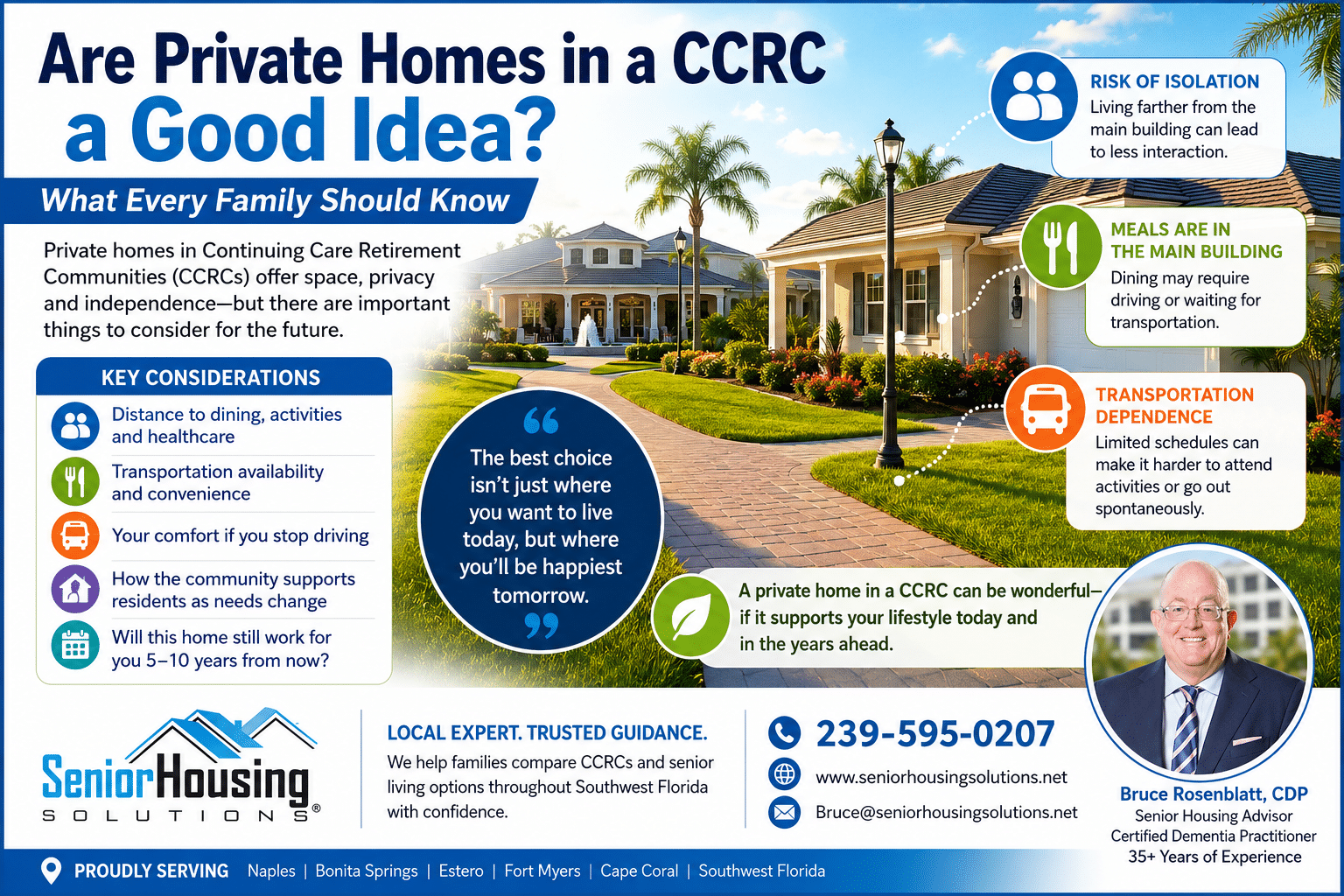
Are Private Homes in a CCRC a Good Idea?

Are Private Homes in a Continuing Care Retirement Community (CCRC) a Good Idea?

What Every Family Should Know Before Choosing a Cottage or Villa

When many people tour a Continuing Care Retirement Community (CCRC)—also known as a Life Plan Community—they're immediately drawn to the beautiful private cottages, villas, and single-family homes. They offer privacy, extra space, attached garages, and a neighborhood feel that closely resembles traditional homeownership.

But are they the best choice for your future?

As a Senior Housing Advisor with more than 35 years of experience, I've helped hundreds of families evaluate CCRCs throughout Southwest Florida. While private homes can be an excellent option for some, they also present challenges that many people don't consider until years later.

Here's what you should know before making this important decision.

The Appeal of Private Homes

There's no denying the advantages.

Private homes within a CCRC typically offer:

  • Spacious floor plans
  • Greater privacy
  • Attached garages
  • Outdoor patios or lanais
  • Beautiful landscaping
  • A true residential neighborhood feel
  • Maintenance-free lawn care and exterior upkeep

For active retirees, this lifestyle can be very attractive. Residents enjoy the comfort of a private home while knowing higher levels of care—assisted living, memory care, and skilled nursing—are available if their needs change.

However, the decision shouldn't be based solely on how the home feels today.

Think About Life Five to Ten Years From Now

One of the biggest mistakes I see families make is choosing the largest or nicest home without considering how aging may affect daily life.

Ask yourself:

"Will this home still be convenient if I no longer drive or have mobility challenges?"

That question often changes everything.

The Hidden Challenges of Private Homes in a CCRC

1. Social Isolation Can Become a Real Concern

Many cottages and villas are located away from the community's main building.

While this creates privacy, it can also reduce spontaneous interactions with neighbors.

As mobility declines, many residents begin skipping activities because getting there simply becomes more difficult.

Isolation is one of the greatest risks to healthy aging. Regular social engagement has been linked to improved emotional well-being, better cognitive health, and a higher quality of life.

2. Dining May Require More Effort Than Expected

Most CCRCs have their primary dining venues inside the clubhouse or main community building.

Residents living in detached homes may need to:

  • Walk long distances
  • Drive to dinner
  • Wait for scheduled transportation
  • Avoid meals during bad weather

Over time, many residents begin eating at home more often, missing both the meal and the social experience that comes with it.

3. Transportation Can Limit Independence

Initially, most residents drive.

Eventually, many stop driving due to vision changes, slower reflexes, or personal choice.

If transportation within the community operates only on scheduled routes, spontaneous trips to lunch, fitness classes, or social events become more difficult.

Before choosing a private home, ask:

  • Is transportation available all day?
  • Is golf cart service provided?
  • Can residents request rides?
  • How easy is it to reach the clubhouse?

4. Activities Are Usually in the Main Building

Fitness classes.

Educational lectures.

Live entertainment.

Religious services.

Card games.

Movie nights.

Most community activities occur in one central location.

The farther you live from these amenities, the less likely you may be to participate regularly—especially as mobility changes.

Convenience often determines participation.

5. Emergency Response May Take Longer

Although CCRCs have emergency response systems, detached homes are naturally farther from staff than apartments located within the main building.

Response protocols vary by community, making it important to ask how emergency calls are handled.

6. Larger Homes Can Become More Difficult to Manage

Even with exterior maintenance included, residents may still be responsible for:

  • Interior maintenance
  • Appliance replacement
  • HVAC systems
  • Plumbing repairs
  • Home organization

What feels comfortable at age 70 may feel overwhelming at age 85.

Apartment vs. Cottage: Which Is Better?

There isn't one right answer.

A private home may be ideal if you:

  • Are very active
  • Enjoy entertaining
  • Want additional space
  • Expect to live independently for many years

An apartment closer to the clubhouse may be better if you value:

  • Daily social interaction
  • Easy access to dining
  • Short walks to activities
  • Convenience without transportation concerns
  • Reduced isolation

Many residents eventually discover that proximity to people is more valuable than extra square footage.

Questions to Ask Before Choosing a Private Home

Before signing a contract, ask:

  • How far is the home from dining and activities?
  • Is transportation available throughout the day?
  • What happens if I stop driving?
  • Is there covered access during rain?
  • How often do residents relocate from cottages to apartments?
  • What maintenance responsibilities remain mine?
  • What healthcare services are included in my CCRC contract?

My Advice as a Senior Housing Advisor

After more than three decades in senior housing, I've learned that choosing a CCRC isn't just about selecting a beautiful home.

It's about choosing the lifestyle that will serve you best as you age.

When touring a community, don't simply ask:

"Could I live here today?"

Instead ask:

"Will this still work for me ten years from now?"

The answer may lead you to a different—and ultimately better—decision.

Need Help Comparing CCRCs in Southwest Florida?

Every Continuing Care Retirement Community has different contracts, healthcare benefits, entrance fees, refund policies, and residential options.

At Senior Housing Solutions, we help families compare communities objectively so they can make informed decisions with confidence. We also assist with scheduling tours, evaluating contracts, comparing costs, and understanding the long-term advantages and disadvantages of each option.

If you're considering a CCRC in Naples, Bonita Springs, Estero, Fort Myers, or anywhere in Southwest Florida, we're here to help.

Contact Bruce Rosenblatt, CDP
Senior Housing Solutions – Assisted Living Advisors
📞 239-595-0207
🌐 www.seniorhousingsolutions.net


Dine, Discover & Connect | Senior Living Tours in Naples, FL

FAQ Schema (JSON-LD)
Dine, Discover & Connect

Dine, Discover & Connect | Senior Living Tours in Naples, FL

Looking for the right senior living community but not sure where to start?

Choosing a senior living community is one of the most important decisions a family can make. With so many options for independent living, assisted living, memory care, and Continuing Care Retirement Communities (CCRCs), it can be overwhelming to know where to begin.

That's why Senior Housing Solutions created Dine, Discover & Connect—a unique monthly luncheon series that allows seniors, adult children, and caregivers to comfortably explore exceptional senior living communities throughout Naples, Bonita Springs, Estero, Fort Myers, Marco Island, and Southwest Florida.

Instead of scheduling multiple individual tours, you can enjoy a complimentary lunch, meet new people, and experience a community in a relaxed, welcoming environment.

What Is Dine, Discover & Connect?

Dine, Discover & Connect is more than just a community tour.

Each month, participants visit a different senior living community to:

  • Enjoy a complimentary chef-prepared lunch
  • Tour the community with knowledgeable staff
  • Learn about different levels of senior living
  • Ask questions in a comfortable, no-pressure environment
  • Meet others who are also planning for the future
  • Gain valuable education from experienced Senior Housing Advisors

Whether you're actively searching or simply planning ahead, these events provide an excellent opportunity to become familiar with the many senior living options available in Southwest Florida.

Why Attend?

Many families don't begin researching senior living until a health crisis occurs. Unfortunately, making important decisions during an emergency often leads to unnecessary stress.

Attending Dine, Discover & Connect allows you to explore your options before you need them.

Benefits include:

  • Learn the differences between Independent Living, Assisted Living, Memory Care, and CCRCs.
  • Experience each community's atmosphere firsthand.
  • Sample the dining experience.
  • Meet residents and staff.
  • Ask questions without feeling pressured.
  • Compare multiple communities over time.
  • Build confidence for future planning.

Knowledge today can prevent difficult decisions tomorrow.

Why Families Trust Senior Housing Solutions

For more than 35 years, Bruce Rosenblatt, CDP, Founder of Senior Housing Solutions, has helped thousands of seniors and their families navigate senior housing decisions.

Unlike national referral companies, Senior Housing Solutions provides:

  • Personalized recommendations
  • Local expertise
  • Extensive knowledge of Southwest Florida communities
  • Personalized tours
  • Honest, unbiased guidance
  • Assistance with comparing communities and care options

Our goal is simple:

Help families make informed decisions with confidence.

Who Should Attend?

Our monthly events are perfect for:

  • Seniors exploring retirement living
  • Adult children helping aging parents
  • Caregivers
  • Financial planners
  • Elder law attorneys
  • Healthcare professionals
  • Realtors
  • Anyone interested in planning for future senior housing needs

Even if you're not ready to move today, learning about your options now can save time, money, and stress later.

There Is Never Any Cost to Attend

One of the best parts of Dine, Discover & Connect is that participation is completely FREE.

There is:

  • No obligation
  • No sales pressure
  • No membership fee

Simply RSVP, enjoy lunch, tour a beautiful community, and leave better informed than when you arrived.

Join Us at an Upcoming Dine, Discover & Connect Event

Every month we visit a different senior living community throughout Southwest Florida, giving attendees the opportunity to compare communities while enjoying great food and meaningful conversations.

Good Food. Great Conversations. New Possibilities.

Space is limited for each event, so advance registration is required.

Call 239-595-0207 to reserve your seat or visit

www.seniorhousingsolutions.net to learn about upcoming events.

About Senior Housing Solutions

Senior Housing Solutions is Southwest Florida's trusted senior housing advisory service. Since 2008, we have helped thousands of families find the right Independent Living, Assisted Living, Memory Care, and Continuing Care Retirement Communities throughout Naples, Bonita Springs, Estero, Fort Myers, Cape Coral, and Marco Island.

With over 35 years of senior housing experience, Bruce Rosenblatt, CDP, is known as "The Matchmaker of Senior Housing," providing compassionate, personalized guidance that helps families make informed decisions with confidence.

Ready to discover your options?

Join us at the next Dine, Discover & Connect event and experience senior living in a relaxed, educational, and enjoyable way.

Frequently Asked Questions About Dine, Discover & Connect

What is Dine, Discover & Connect?

Dine, Discover & Connect is a monthly luncheon and educational tour hosted by Senior Housing Solutions. Each event is held at a different senior living community in Southwest Florida, allowing attendees to enjoy a complimentary lunch, tour the community, and learn about senior living options in a relaxed, no-pressure environment.

Who should attend?

These events are ideal for:

  • Seniors planning for the future
  • Adult children helping aging parents
  • Caregivers
  • Healthcare professionals
  • Financial planners
  • Realtors
  • Anyone interested in learning more about independent living, assisted living, memory care, or Continuing Care Retirement Communities (CCRCs).

Is there a cost to attend?

No. Dine, Discover & Connect events are completely complimentary. There is no charge to attend, but advance RSVP is required because seating is limited.

What can I expect at the event?

Guests enjoy a chef-prepared lunch, tour the community, meet staff, ask questions, and receive educational guidance from Bruce Rosenblatt, CDP, and the Senior Housing Solutions team. Every event is designed to help families make informed decisions without sales pressure.

Do I have to be ready to move?

Not at all. Many attendees are simply planning ahead or exploring future options. Learning about senior living before a crisis occurs can make future decisions much easier.

Which types of senior living communities do you visit?

Throughout the year, we visit a variety of communities, including:

  • Independent Living
  • Assisted Living
  • Memory Care
  • Continuing Care Retirement Communities (CCRCs)

This allows attendees to compare different lifestyles, services, amenities, and care options.

How often are Dine, Discover & Connect events held?

Events are typically held once each month at a different senior living community throughout Naples, Bonita Springs, Estero, Fort Myers, Marco Island, and surrounding Southwest Florida communities.

How do I reserve a seat?

Simply call 239-595-0207 or visit

Webroot Classification: green

www.seniorhousingsolutions.net to RSVP. Seating is limited, so early registration is recommended.